Social Media Crisis Prevention

Image licensed through Adobe Photo Stock 2023

What Not to Do

Since the beginning of social media and the viral spread of knowledge that comes with it, we have seen some unfortunate examples of what not to do when it comes to crisis management. First of all, what constitutes a social media crisis to begin with? Simply put, a social media crisis is anything that could negatively impact your business’s reputation and reception through social media. Imagine one day waking up to a slew of notifications that your brand has received numerous negative responses to a post you or someone on your team created. In 2018, surely the CEO of Meta (then Facebook) Mark Zuckerberg woke up to panic when it was discovered that Facebook had a major data breach in relation to Cambridge Analytica. You would not know it, however, not by the way he handled the situation.

Typically, in a crisis situation, even 15 minutes is too long to wait to respond in order to get ahead of the crisis. Zuckerberg took four days to respond, and even when he did, there was little to no apology in sight. Four days of headlines asking where he was and Facebook users jumping off the platform and demanding action from Zuckerberg all led to a very chaotic and more advanced crisis situation than was necessary. Not only that but the Facebook brand was permanently damaged due to a lack of trust in the company. What we learned from this poor example of crisis management is that marketers and PR teams need to have a plan for how to manage these types of situations and that plan most certainly needs to include rapid response. Proactively, especially when it comes to user data, transparency with users and taking advanced steps towards protecting their data should be common practices to prevent data hacks and cultivate trust with users and stakeholders.

What You Should Do

While there are plenty of examples of poor responses to social media crisis management, there are even more examples of success. Do you remember when KFC (Kentucky Fried Chicken) ran out of chicken? Talk about a crisis! They took immediate action to let the public know why there was a chicken shortage, what they were doing to fix the situation and they did an excellent job of keeping their customers up to date over social media. That said, what I appreciate most about their strategy was that they had a strong understanding of who their customer base is and were able to formulate an appropriate response, with a touch of humor.

In addition to an apology, they knew that the British public had a sense of humor and appreciate a joke. The advertisement above went out and the response was positive. If they didn’t know their audience well enough, they may have been less likely to take such a risk, so it’s important that in order to mitigate crises, brands engage with their audience and gather feedback from the employees at their company who know their audience best.

In February of 2022, I working from home and our company’s main tool for staying connected while working remotely was Slack. Slack is an online messaging application and that month, for whatever reason, the app went down. I remember being confused, management and higher-ups were monitoring the situation and sharing Slack company updates. Temporarily, we switched to Google Chat and enjoyed the transparent, timely updates from Slack as to when they would be available for use again. After the issue was identified, Slack provided regular updates to users via their status page approximately every half hour. 
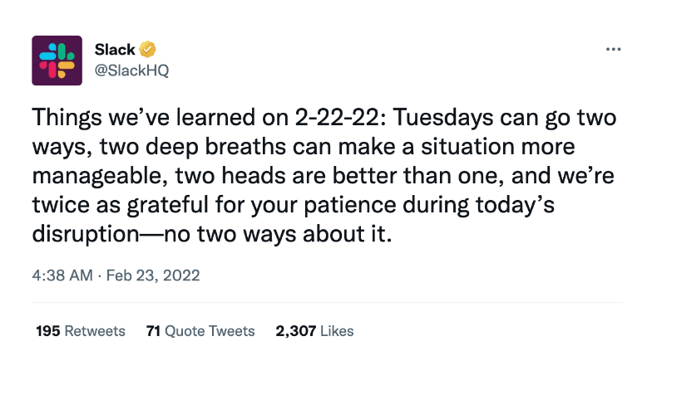
Once again, we see a company that knows its audience and introduces some humor in order to create a light-hearted but considerate update. By being down to earth in their updates, they reminded their users that they too are human and not free from error. I remember when our CEO shared this Tweet and how we all laughed about it later and talked about how we appreciated the clever post. Other people Tweeted similar responses:

So now that you understand some do’s and don’ts when it comes to social media crisis management, what steps have you taken to ensure you’re in good standing when a crisis hits? Need more information? Check out my links below for crisis management resources and guides:

Hootsuite – Tips on social media crisis management

HubSpot – Free Template

Bandwatch – A paid tool that helps you keep track of what people are saying about your brand over 100 sources, and more.

Mention – Enables brands and agencies to monitor the web, listen to their audience, and manage social media.

My Experience with The Digital Divide

Imaged licensed through Adobe PhotoStock 2023

2023 and yes, it still exists.

For those of you who may be unfamiliar with the term “Digital Divide” what I’m referring to is the basic fact that while some have access to quality, high-speed, affordable internet -others do not. Globally, the United States is doing pretty well with internet access compared to other countries, however, we have a ways to go before everyone has the same opportunity as everyone else where internet access, infrastructure, and costs are equal. You may experience some of the effects of the digital divide yourself, or know someone who does. Today, I’m going to bring the conversation close to home and discuss my own experience with the digital divide.

To start, I’ve lived in the same town for most of my life with short 1 to 2-year stints living in other areas within an hour or two of my hometown. My hometown of Redding, CA is urban and considered a small city with a population size of about 93,000 people. There are a few ways in which someone might feel the negative effects of the divide and those could be either monetary-based and/or based on location and infrastructure access. Since getting with my now husband in 2016, we have moved a lot and we have mostly experienced the location and infrastructure side of the problem as being our greatest issue. I remember nights when my husband would be gaming with his friends and I would need to upload an assignment for work and I would have to wait until he was out of a match -or something to that effect, before I could upload it so that he would not “lag” or get booted from his game. This was not a problem at all where he was concerned, he worked hard all day and I wanted him to be happy. The problem came from the lack of quality internet and we were paying at least $80/month for this poor-quality internet however, it was the best we could find in the area at the time. This would play out as a similar struggle in the following couple of places we would live.

Fast forward to 2020, I’m still in school, it’s Covid mania and we were sent with all of our office supplies to work from home until further notice in Chico, CA. Both of our jobs would state that basically, they found remote work to be doable if not beneficial to our companies and we could stay working remotely forever if we wanted. Um, yes -thank you. So, in the summer of 2020, we decided to start looking to purchase a home, and since we could live anywhere now that we could permanently work from home, my husband and I purchased our house in our hometown to be closer to family. Our new home is pretty centrally located in the city, so we didn’t think internet access would be a problem. When we toured what would become our first 30-year loan, we noticed that everyone around us had Charter/Spectrum high-speed internet and we were thrilled. This home was amazing and the idea of having that access was enough to put us over the moon.

Before we put an offer in on our home, we checked with Charter to make doubly certain that we would be able to get the hook-up after we moved in. Amazingly enough, they said they could have a technician come out before our move-in date and so we set it up. Excited, we meet the guy at the house and he walks around for a few minutes and then comes over to tell us that he cannot connect us and that whoever we spoke to on the phone misinformed us. Baffled, we stated that literally all of our neighbors around us have their internet, so why not us? Being the bearer of bad news, he told us that our home had been constructed after the main line had been put in, and if we wanted to connect to that line, we would need to pay $14,000.00 for the cost of construction that it would take to add us to the line and then connect it to our home. You read that right, a multi-billion dollar company wanted us to pay thousands in order to be added to their infrastructure. According to Macrotrends, Charter Communications’ net worth as of May 04, 2023, is $54.48B. Yet they wanted us to pay.

After some discussion and negotiation from my husband, they said they’d be willing to cover around $4k, leaving us to foot a bill of $10k with no option to do payments and they would not begin until we had paid in full. So, to recap, we just bought a house. We did not plan for this extra drain on our savings and we could not do it. We spent the next month away from our new home, working remotely from my in-law’s spare room, all the while checking locally to find some solution that would work for us. Or needs were not small, we both worked from home, I was also taking online classes and we also had smart systems in our home which used the internet from our gaming devices to our Alexa and security devices. We had to find the best quality of high-speed internet we could and we tested at least three out until we caught a lucky break.

Fortunately, due to my husband’s diligence and resourcefulness to find another solution, we came across Elon Musk’s new satellite internet solution called StarLink. At the time, it was in Beta testing still, however, all of the reviews that were coming in were very positive from other early testers and Elon’s plan was to continue to put more satellites into inter-orbit as time went on, which would mean that the quality of internet would only get better. The upload and download speeds that we were seeing from other users had us sold and we got on the waiting list for our area. As soon as our location became available for StarLink, my husband snatched up a satellite and we began our $100/month payment plan. Easily enough, we installed the satellite and rarely and more rarely ran into any issues or lags. It was better and cheaper than any other service we had tried and best of all, we no longer needed to keep the dreaded idea of paying Charter on the table.

Fast forward to today, May 5 of 2023 and we are still using StarLink. The quality of the internet has improved, there are no data caps, and all is well. About once every 6-7 months, a different salesman with Charter will come out and knock on our door to see if we are interested in connecting. Each time we have told them of our plight (because they fail apparently to take any notes), we still feel fiber internet would be preferable to satellite internet and StarLink mentioned they might start imposing data caps. Each time we open our door to discussion once again in hopes of some change of heart from their end, but to no avail. Most recently we were told that Charter was given a substantial amount of grant money in our area in order to connect local households to their fiber internet and once again our hopes were ignited. Yet, when it came down to it, they still wanted us to pay and they still didn’t offer a payment plan – despite what the salesman said. Lots of promises of inquiries, making it happen for us, phone calls, and nothing to show for it. So sick of Charter, last week when yet another salesman came up to me while I was doing work out in the yard, I could not help but pour some salt and immediately turned him away. Now, get this, the next day, my husband got an email stating that StarLink will not be imposing data caps! So, here we go onward with StarLink until further notice.

The frustration has been real and quite frankly, I know we don’t have it nearly as bad as so many others. What’s your internet divide story?

If you’ve been through it, we definitely recommend StarLink to anyone who is looking for a better alternative. Check out this link to see if they service your area and get on the waitlist to be notified when it comes to your location if not.

Good luck!

Social Media and Education

Learning Through Social Media

As good designers, we are constantly looking for ways to improve our skills, enhance our knowledge base, and learn about something new. Today, more than ever before, social media has become a conduit for learning and teaching online. The benefits of teaching through social media platforms like LinkedIn, Youtube, and Instagram are many and include the ability to review and make edits of recorded lessons, reach a wider audience than you would in a traditional setting, and obtain reviews that could potentially help your business gain more customers. As a learner, you are able to become more aware of educational content that may be useful to you, view reviews and ratings for the content to help you make the best decision when it comes to choosing who you will learn from, and benefit from flexible learning due to the 24/7 availability of accessing the content. Not to mention, a lot of educational content is free to the user like a lot of what you might find on Youtube due to the payment methods and policies they have in place with the person who posts the content.

When you attend an accredited university, you know as a student that you can trust that the information you are receiving in class from your instructors is correct and current, but how do we as social media consumers know if the information shared on social media is accurate? What if it’s a scam? As we all probably should know, just because there is a post that claims something or shares a lovely quote by someone, we can’t always be certain that what we are seeing is valid. On the same note, it has become more and more of a taboo to share or like posts that include misinformation, so before we share – we check. The same thing goes for educational material on social media; we must check out the source and if possible check reviews from other users to see if we can validate the content and the individual teaching it. If you don’t do your due diligence this way, you may fall victim to a scam resulting in your personal data being hacked, money fraud, and many other unfortunate consequences.

There is no doubt that in the 21st century, social media is a prevalent force enabling users to express their thoughts, voice their opinions, and connect to each other anytime and from anywhere. The appeal of social media as a learning platform is in large part due to the ability to participate by viewing, creating, and sharing content and the knowledge it offers. Learners are also able to share their attitudes, beliefs, and perceptions, and cultivates a user-centered environment that is social, personalized, and interactive. As an educator, and yes if you’re teaching how to do something online then you to are an educator, it’s important to recognize that successful learning outcomes depend on the goals and objectives that drive the design of instructional strategies and the selection of social media platforms. Not every platform may be best suited to learn from just the same as not every platform may be the best choice to share particular educational content. I have linked some of the best tools for sharing content and what type of content is below. This list will help you whether you are seeking something new to learn or a way to share your knowledge and skills.

Social Platforms and Learning Content List

Facebook Page: use for broadcasting updates and alerts. Familiar alternative to having users download and learn how to use another messaging platform like Slack. Instructors can use it to post class updates, share assignments and encourage discussion.

Facebook Group: use to stream live lectures and host discussions. Instructors can also post discussions, assign homework and make class announcements here.

Twitter: use as a message board or discussion board. The 280-character limit makes students/users think critically about communicating concisely and effectively which is another beneficial skill. Teachers can also create discussions and Twitter chats surrounding a specific hashtag that they create.

Instagram: use to present a series of photos or graphics in a visually appealing way. Instagram allows students to practice digital storytelling in ways that other social media platforms do not. As a learner, you can create a class-specific account and then delete them after the course has been completed if you choose.

Blogs: create a class blog for discussions. There are many different platforms available such as WordPress, Squarespace, Wix, Blogger, and more. Learners can create their own user accounts to make discussion posts or add comments on class prompts. Blog posts as essays or short-form writing is another strategy for combining social media and learning. Learners can respond to weekly prompts making it as informal and loosely structured as possible as well as this method can be transferred across all subjects.

Pinterest: create a class-specific Pinterest board where you as the instructor can save pins that are relevant to the lessons you are teaching. It’s a great platform to help instructors prepare and organize resources, lesson plans, and worksheets in one place. For learners, it’s useful to curate a digital bibliography for research projects, papers, or group assignments. Learners can pin websites, books, or videos to a board on a single topic and refer back to it when it’s time to write.

Youtube: used to teach and to learn by sharing content and viewing that content. Instructors can share their structured videos of their content, gain followers and ratings as well as answer questions or give feedback to viewers. Learners can access the content by searching for a specific topic, viewing the top content creators for that subject, interacting with other learners and the teacher, subscribe to the instructor to stay up-to-date on their latest content uploads, as well as access it at any time from anywhere.

LinkedIn: similar to YouTube, LinkedIn allows for the ability for professionals to share their wealth of knowledge for free or at a price. Learners can again have unlimited access to the content and know that it comes from a reputable source. Learners can follow the instructor, message them directly, and even connect with other learners.

Final Thoughts

Social media for learning allows learners to gain a sense of community and belongingness. It also is the fastest way to contact people or share crucial information. As an instructor, it can help you make your approach more student-centered. Social media is easily accessible and most modern-day learners have a digital presence already making them highly familiar with the ins and outs of social media platforms.

So, embracing social media and incorporating its features into the teaching and learning processes can have a positive impact on learners. Instructors can provide video lectures, and quizzes, tag learners, and have them participate in group discussions. In this way, learners will not only gain knowledge in an interesting and engaging way but will also get the flexibility to learn from wherever they want and whenever they want.

Great Businesses Use Effective Graphic Design On Social

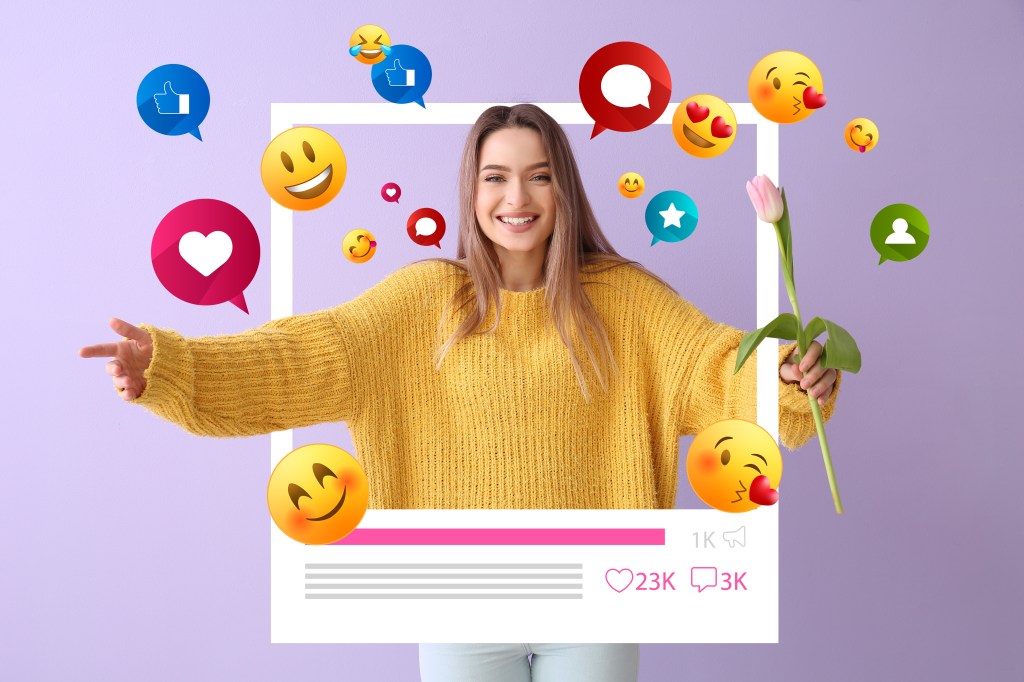
Image licensed through Adobe Photostock 2023.

Business was forever changed with the introduction of social media. Companies can now use several innovative methods to connect with their audience all around the globe, and graphic design plays a major role in making that happen. Popular platforms like Facebook, Twitter, Instagram, and more allow businesses a platform to help them stand out from the crowd and grow relationships with new and existing customers. Imagery is a huge factor in that success and according to Hubspot, a top source for digital marketing strategy, people following directions with text and illustrations do 323% better than those following without graphics or pictures. If you’re struggling to engage your audience, ask yourself if your marketing includes graphics, and then take a look at some of the best brands that excel at incorporating graphics in their marketing strategy.

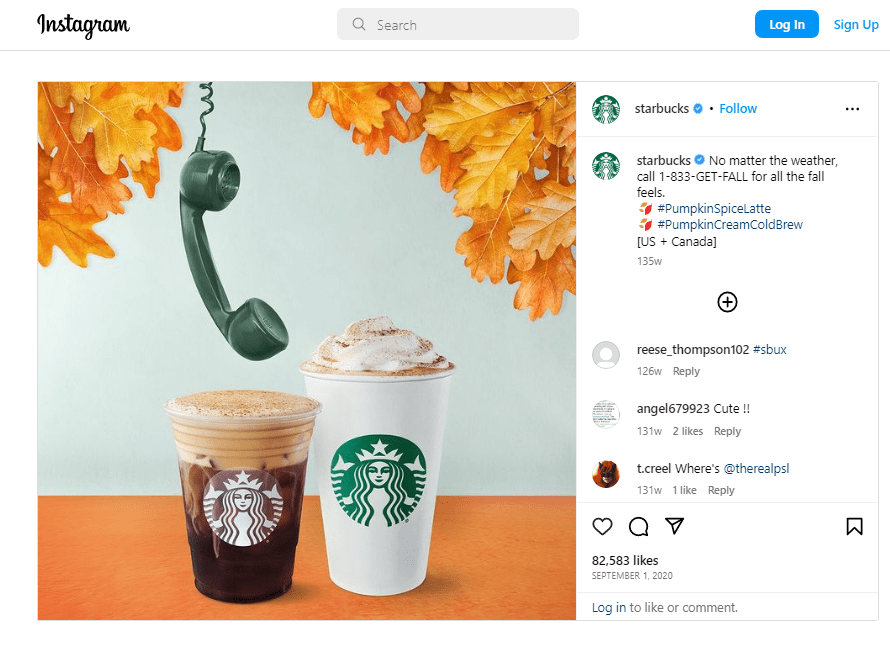
Six of the best brands that I can think of that really nail graphic design for social media are Spotify, Starbucks, Oreo, Mailchimp, Netflix, and Shopify. In 2020, Spotify came out with their #2020wrapped campaign as a way to grab their audience’s attention. More than just a social media hashtag, it showcased Spotify users’ most-played songs, favorite bands, and podcasts in an easily sharable, clean, and simple-looking infographic. Starbucks, while they lack fair wages and treatment of partners, does not lack in graphic design material. In the image below from their 2020 fall campaign, by adding the phone, you as an audience member are now not just looking at another coffee and Fall aesthetic photo, but something interesting that you want to learn more about. It’s unusual and so now you simply must read the subject matter and find out that there is an 800 number to call to order your Pumpkin Spice Late for delivery.

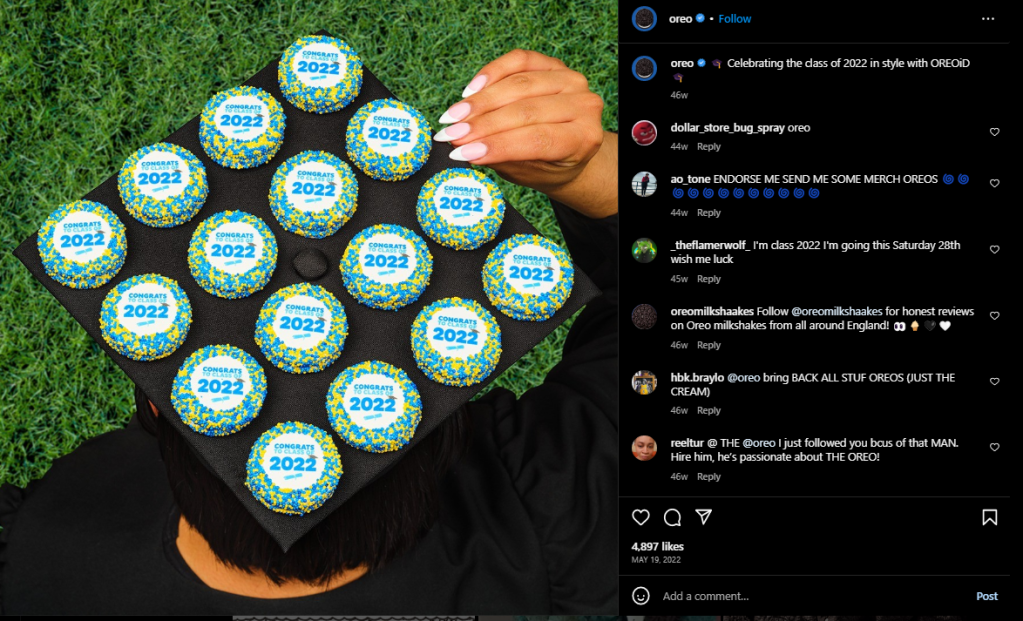
The article 5 Ways To Engage Consumers On Social Media in this week’s reading list claims that by using humor on social media, you can increase engagement with current customers and grow your follower count when people share your post with their friends. Oreo does an excellent job of cleverly using images of their product in different funny scenarios that match a current trend or message. In this image Oreo designers showcase their Graduation Oreos during the Spring of 2022.

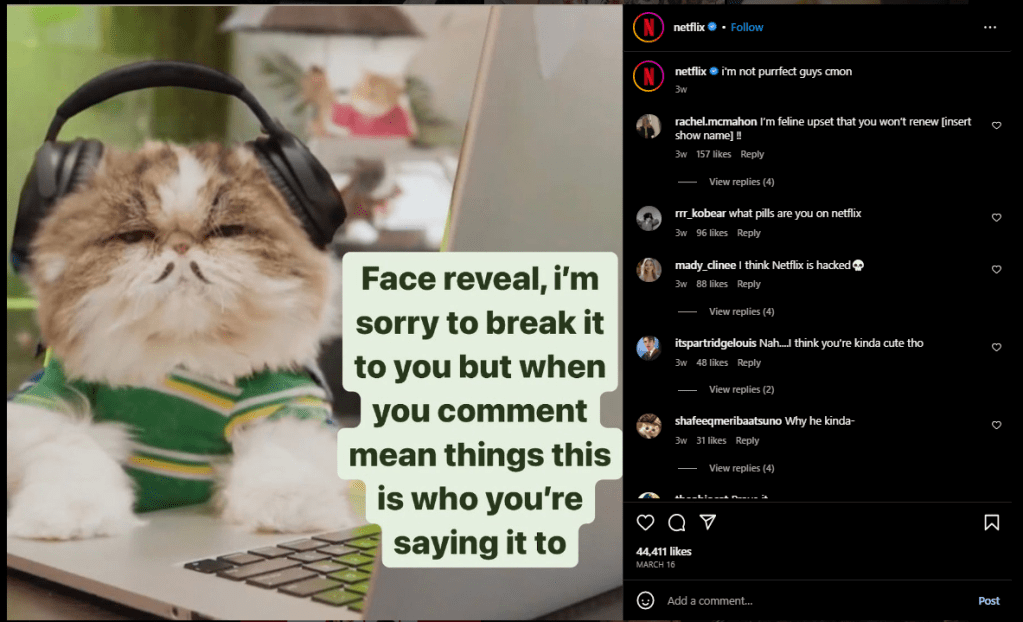
Just a few more graphics that sparked some humor or showed a great design for interest:

It’s pretty clear that graphic designers are integral to excellent marketing strategy. We must be clear that while there are tools for non-designer marketers to use to help them incorporate graphics in their social media strategy, marketers are not versed in design concepts or the principles of design. If you’re looking for a way to incorporate more graphic design in your social media outreach, consider adding a graphic designer or two to your marketing team – you can thank me later!

Political Design On Social Media

Photo licensed through Adobe Photostock 2023.

Have you become more engaged in politics due to exposure to social media? When you think about how social media has been impacted by politics, it’s pretty easy to imagine that what first drew your attention was an image whether that image was taken with a camera or digitally designed. Effective communication begins with the visual and is enforced by what is written or talked about regarding that image. Effective imagery encompasses colors that depict the mood of the topic, icons that are universal, and sometimes even phrases or slogans that simply and clearly explain the topic. Today I want to discuss what makes an effective social media campaign and how designers play a pivotal role in helping campaigns succeed, as well as our responsibility as designers to design with integrity and truth.

As we all know at this point, people in politics lie. They blatantly lie or omit truths so that their arguments prevail over facts and reason. So what about political campaign ads? Can they lie in those also? The short, unfortunate answer is yes. The Honest Ads Act was a bill in the United States Senate intended to regulate online campaign advertisements by companies. The bill was proposed on October 19, 2017, as a response to Facebook’s disclosure of Russia purchasing political ads during the 2016 United States presidential election. The Honest Ads Act was eventually incorporated into the For the People Act, which passed the House but stalled in the Senate during the 116th and 117th Congress. As designers, we have a responsibility to turn away a paycheck when it comes to false or misleading information being presented to the public as truth. Any designer who is willing to subscribe to shady practices should be held accountable and while the United States has attempted to wrangle this problem, we have sorely fallen short.

Now that we are designing campaign ads responsibly, let’s talk more about what makes for great social media design for political campaigns. Similar to the thought process behind creating excellent marketing campaigns for social, designers can also consider five main things when planning a political social media campaign: if this is not your first time, audit your previous social media performance, define your campaign goals, create audience personas, identify distribution channels and key times to post and last, check out your competitors.

Audit your previous social media performance:

Carefully review the metrics from each social channel you used so that you can see where and how you have generated leads, driven traffic to your website, gained social follows, and increased conversions – in this case a conversion could be considered as signing up to vote, signing a petition or subscribing to an email list or newsletter. Tracking these metrics helps you and your team understand whether or not you have been successfully meeting your goals.

Define your goals for the year:

Think about the goals you have and try to break them down into categories that align with your wider goals. If you want people to sign a petition, donate to the campaign, and engage on social media, you might categorize your goals in two ways: branding goals and revenue-linked goals. For branding goals, you might include how many people you want to reach within a time frame, how many relationships you create, post engagement for the month, how many shares you acquire, etc. Revenue-linked goals might look something like how many sign-ups you received in a month or how much money you raised in a certain amount of time. Remember to always keep your goals SMART too. That is, Specific, Measurable, Achievable, Relevant, and Time-bound, so that you can gauge your performance.

Create audience personas:

Sure, why not? If you are trying to raise funding and awareness for your campaign, as a designer you know how to create user personas and they can be very helpful when trying to reach certain demographics at certain times. Do you need millennial buy-in? Well, take a look at when they’re on social, what the typical millennial is up to during a routine day, and when you will most likely be able to reach them. Know your audience through personas by identifying their struggles and pain points. Are they worried about fires? Polluted water? The ads designed with those concerns in mind will help you target those groups. Many millennials are parents now, so maybe they’re worried about their child’s education and gun regulation. Your candidate is pro-gun reform and education funding so now go design the eye-popping ad that will create awareness and hopefully lead to donations for your campaign.

Identify distribution channels and key times to post:

When trying to reach your audience, knowing what social media platforms they use and what times they use them can increase the likelihood that your campaign ads will be seen. According to Statista, in 2020, 59% of marketers said that Facebook was their most effective social channel, with Instagram at 17%, LinkedIn at 14%, Twitter at 3%, and Pinterest at 1%. That gives a good big-picture view, but knowledge of how your own brand and audience interact on social is even more powerful. Know where your audience goes and when they’re most likely to see your ad.

Check out your competitors:

Who are your closest competitors? Which social media channels are they using? How are they successful? How are they missing the mark? What type of content are they producing and how effective is it? Where do they need to improve? A type of “social media listening”, reviewing your competition is an effective way to monitor the sentiment around your competitors’ campaigns. Then take these gained insights and implement better ways to inform your social media campaign design strategy.

Resources:

Statista

HubSpot and Semrush have additional resources and articles related to marketing strategy that can be useful for campaign design strategy as well.

Social Captial in Design

Social Captial is a relatively new term, but a pretty old concept. According to Sadhana Pasricha, the Founder, and President of Social Capital Consultants LLC, social capital is “a sociological concept that refers to the intangible, invisible resources and assets that emerge from our social interactions and  relationships.” Simply put, it’s what you gain by connecting with others. Social capital is a beautiful thing because it can only ever increase based on those connections and when you’re working in design, or any career really, the resources that become available to you by connecting with others in your field are invaluable. (2)

As a designer, consider what you might gain from your social media accounts if you followed a group like AIGA or your local artist coalition. You could gain intel on upcoming software, design trends, art shows and so much more. If you’re a freelancer, then maybe because you linked up with some local artists, they’re able to refer some work your way because either they don’t have the capacity to take on the task, or the work is more in your ballpark. Social capital grows because the individuals in a network are all interconnected and while Dave is great at web designer, he doesn’t feel as confident with motion design and so he outsources that aspect to Sierra who is an expert. Due to this social connection, two people within a network made money and the client was impressed because all of their goals were met with excellence.

Before Dave referred Sierra, however, they had to meet somehow and that is where social networking came into play. By following other designers of similar and different backgrounds on social networking sites like LinkedIn, Instagram, Youtube, and more, you not only can learn more about your industry but can also gain valuable insight and professional relationships which can help you further down the road. By posting regularly, and sharing your own insights and skills, you showcase yourself and attract an audience of followers who engage with your posts. This following and engagement help to build trust about who you are and what you offer.

Social capital improves reputation by expanding the range of people who are aware of you and what you do. By word of mouth and by visible comments and likes on your work, more people will come to know you as reliable and trustworthy. There are many ways to build social capital including linking your social networks to your portfolio, website, resume, and other social networks. If you have a blog, you can connect it to your website and other forms of communication tools that you use. Expanding the number of social tools you use, the further reach you will have to a wider audience as well. The more people you know, the more likely you will increase your access to the potential ability to obtain resources, favors, or information from one’s personal connections. (3)

Researchers have identified three different types of social capital, bonding, bridging, and linking. Bonding refers to social capital created within a group with shared interests and goals. A neighborhood association is a good example of how bonding works. Bridging, on the other hand, is the creation of social capital across groups. When bridging is successful, individuals in the two groups discover shared interests and goals and work together to achieve them. A neighborhood association that links up with a local police department is an example of how bridging works. Similar to bridging, linking creates ties across groups, but those that span different socioeconomic groups. Linking has been associated with increasing one’s chances of upward social mobility. (1)

  1. Chetty, Raj, et al. “Social capital I: measurement and associations with economic mobility.” Nature, vol. 608, no. 7921, 2022, pp. 108-121.
  2. Pasricha, Sadhana. “Social Capital — the critical assets for success.” TEDxWilmington. https://www.youtube.com/watch?v=nqwTRl9cdn4.
  3. University of North Carolina. “Social Capital – Health & Economic Benefits of Connecting While Distancing.” https://ncimpact.sog.unc.edu/2020/11/social-capital-staying-connected-during-distancing/#:~:text=Research%20consistently%20shows%20important%20benefits,result%20of%20their%20positive%20relationships.

Social Networking Elevated with Visual Communication

Image licensed through Adobe Photo Stock.

It’s probably not surprising that perhaps the best way to incite engagement on social media is by using visual aids. Graphic designers are probably thinking, “Well, yeah – that’s obvious!” – however, marketing efforts have increased their visual communication to include more than just text, moving or not, to catch the attention of their audience in recent years. In fact, according to a Wyzowl Survey taken in 2020, 80% of marketers include visual images in their social efforts, 63% use video, and 35% have embraced live video. Visual communication can set a mood, emphasize information and even make subjects more fun and intriguing due to their emotional appeal. When I think of the many ways in which I have designed for informational purposes I think of event announcements created for social media, video ads that I drew and animated, infographics, and typographic posters that I designed with movement and visual stimulus.

Think about reading an invitation – maybe it’s an email, and it’s all text and nothing is pictured and there are no visual aids or emphasis being made. How likely are you to retain the information on that invitation? For someone like me who is a big fan of visual aids, I would have to probably print it and post it to my fridge so I wouldn’t forget…then probably forget anyways. So, when it comes to social media engagement, it makes sense that you will capture not only the attention of your audience better with visual communication, but that they will also more likely remember what the post was about.

Looking at visual communication in social media from another angle, have you ever noticed that some Instagram users’ profile pages are nicely color-coordinated and have a similar aesthetic from post to post? Well, what purpose does that serve to have your page unified looking? Why should I care if my Instagram posts are pretty or have a theme? A good example I could give to help answer these questions is logo design. While having a logo doesn’t make a brand better or a business successful or tell the full story of what a company is about, what a logo does do is create awareness and recognizability. This branding can build trust, credibility, and understanding and without it, the elements of your business would lack unity and ultimately lead to confusion for your audience.

Like a business with a successful logo design, successful IG users, (and I would say successful could mean they have lots of engagement, followers, likes, and purchases), typically have clear messaging and they are easily visually recognizable as you scroll through Stories and Reels. So from adding visual stimulus to the mundane to creating a cohesive, unifying visual design, I think it’s safe to say that social networking is elevated when visual communication is realized.

How we remember

Currently I am working on my story for a book we are creating as a group in my publication design class. The theme that was assigned to us was about the things we keep, which is based on a book (listed below in case you’re interested) that discusses items people take with them and keep; items of value that usually have a personal meaning and are more intrinsically valuable than they are monetarily valuable. I started thinking about what I grabbed when Zach (my husband) and I thought we might not be able to go back to our home in Paradise, CA and this is what I have written so far as a first draft that I thought I would share. I will also continue to share my progress and ultimate book when it is ready. We will be using an online publisher to print, but other than their specifications we are pretty free to design the book how we see fit. It all begins with a story…


We knew we wouldn’t be able to take everything with us as my husband and I headed up an empty Skyway in our little Ford Focus under dark, threatening plumes of smoke. First thing first, we grabbed our two cats and our dog and loaded them up. The threat of fire in Paradise was encroaching closer and the high winds provided little relief for a moment’s thought. What to take? It was one of the first non-practical things I grabbed, hands shaking, voice yelling to Zach that we needed to hurry. If you live in California, chances are you’ve been in danger of fire as sad as that is. In 2018, a week after I was married, I knew I would risk a little moment of time to grab the only remaining piece of my papa that I had; a shadow box I made in his memory after he passed just one year earlier.

Now, this papa is my one and only papa. I didn’t have any other grandparents growing up besides my dad’s parents and words could never express how much they mean to me. My grandma is a saint among women and my papa was like a wise old owl – if owls were actually wise. I would spend countless hours growing up, sitting across from him in his armchair in his den, out in the garage at his workbench, or showing him my latest swimming tricks I had conjured up. You simply cannot help but love someone who listens to you talk, celebrates who you are, and treats you like an equal.

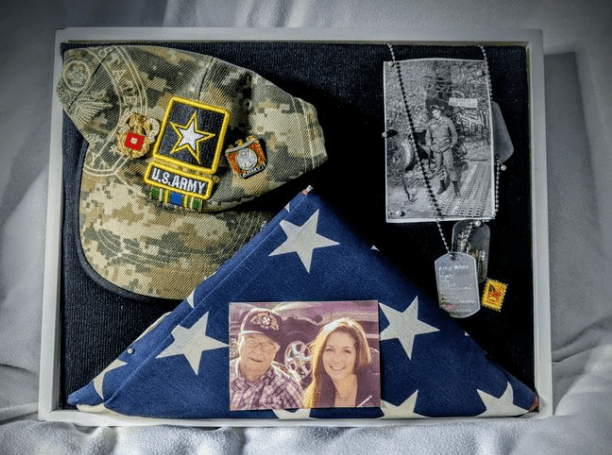
Looking at my box, you will notice a few things. First, you might notice the folded flag with a picture of us on it. That was the flag my Army Veteran papa hung up for me when I deployed overseas in 2015 with the Army National Guard. On the day I returned, he and I both took it down and I folded it as is customary when you retire a flag of the United States. You may have realized that perhaps my papa influenced me to join the Army and you would be correct. The photo on the flag was taken of us both at a Veteran’s Day parade celebrated in my hometown sometime after I returned home from Iraq. It is my favorite photo of us. Moving clockwise you will see one of my papa’s well-worn and favorite Army hats. On this hat you may also take notice of a few Army pins; the one to the left of the star is symbolic of those who were in the Signal Corps and states, “Pro Patria Vigilans”, which means Watchful for the Country and adorns a signal corps flag. That’s right, my papa Nolan Ray Young was a Staff Sergeant in the US Army Signal Corps and the amber pin to the right of the star is the logo for the US Army. Last on his hat, other than the couple strands of his hair, is what is called a ribbon or medal. These are awarded to soldiers for various things and are typically worn on your dress blues, or in my papa’s case as it would’ve been in his day – your dress greens. It is the Korean Defense Service Medal and the photo to the right of his hat was taken while he was deployed in Korea in 1961.

Behind my handsome, young papa there is a sign that says, “Danger High Voltage” and I loved to listen to him explain how he was awarded by a general for keeping the company generators going with such little downtime and how no one else had seen the likes of it before. He had a wonderful way of humble-bragging that seems to be a lost art form today. Next in my box, you will see his dog tags hanging. He gave those to me after I came back from basic training along with a pistol that his father carried when he served in the Army. Don’t worry, that was the very next thing I grabbed. He was so proud of me, I don’t know who between us was happier and I loved to compare my dog tags to his. The difference between them is that his had a puncture on one end where, if you died, they would wedge it between your teeth so they could identify you back home. Such is the morbid reality for soldiers and war. Last, I added a little stamp push-pin. I had to remind myself of the letters we wrote back and forth discussing my new knowledge of interior electrical and celebrating my promotion to E-5. The stamp also reminds me of the money used to purchase stamps that go to fund our military – or at least used to.


My shadow box is filled with the very essence of not only my papa but the connection we had during his life. That connection spurred me to want to serve, encouraged me to get out the words as I handed my grandma his folded flag at the cemetery which would be his final resting place. That connection showed me how to find joy in experimenting, taught me how to question everything, showed me how to listen and, how to be okay with change, how to move forward, how to forgive and be kind to others and to myself. When I couldn’t speak at his funeral while everyone was telling stories because I was shaking and no words could form, only salt in my eyes, I felt somehow I needed to do better. To honor my wonderful papa. This shadow box is my memorial to him and my reminder of everything he taught me and how special he will always be to me.

In Memory of Nolan Ray Young, the best papa in the world.

The inspiration book for our class project:

What Retouched Photos Really Say

Being a woman who has grown up in the digital age, I can honestly say that I have retouched many a photo before posting it to my social media account. Today, I was asked why I chose to filter or alter my photos and that is a question I, up until today, never wanted to sit down with myself and ask. The harsh truth is, however, that I often think I look ugly or fat in the photos that people take of me. When I take the photos, I have the control to chose which one I like best and then to even alter it still to make myself look more beautiful. The sad truth is that I know I’m far from being alone. For many generations before me, women have been dressed by men from the design of their clothes to how they should behave and look at all times. In the 21st century, although we have hard won freedoms, we are still being subjected to the pressure to look “perfect” from the magazines we read, to the pictures we see of famous women, to the photos we ourselves feel compelled to alter just to feel some self esteem.

In France any “commercial” image of a model whose bodily appearance has been digitally or otherwise altered has to be labeled “photographie retouchée,” or retouched photograph. My friends, I think France has got the right idea, but it’s just a start. Why do we retouch photos on a grand scale like this in media? The age old moniker “sex sells” is probably part of it, but money seems to me to be the real root of evil here. If you as a woman, or a man or non-binary person, see someone who looks like you and they’re photo shopped to have perfect skin or the perfect figure, you might not feel so great about yourself. Oh and the one who has perfect skin, well that add is probably selling make-up or acne medication. It’s all a ploy to get you to buy that new piece of gym equipment or membership, get the tan, buy the car or whatever else. America, I think it’s time we said enough.

One bit of good news for anyone tired of comparing themselves to the impossible epitome of perfection is that we might start seeing less of touched-up images. Getty Images, the largest stock photo agency in the world, has declared that it will no longer accept images “depicting models whose body shapes have been retouched to make them look thinner or larger.” My hope is that they would also do the work to remove any images already in their database of edited photos, however I am certainly applauding this effort to change the image of people back to a realistic one. We need to perpetuate a society that loves people just as they are, one that praises imperfections and one that teaches us to love our bodies. One day my husband and I would like to have children and I never want my child to feel like they are inadequate. We need to push this movement forward and encourage all of our idols and media platforms to get rid of the fake and bring in the real.

If you would like to contribute to the cause, I researched some great organizations who are helping to win this battle of self-love for us. Just check out the links below!

https://abc7news.com/fatkini-fat-shaming-curvy-plus-sized/252490/ – “Fatkini” Hashtag went viral in support of women in all sizes looking beautiful in bikinis. Some photos are still altered or filtered, but there is still some groundbreaking improvement here.

https://www.curvykate.com/ – Lengerie for women with them curves! Holy Jesus, it’s about time.

https://now.org/now-foundation/love-your-body/ – You can donate to this awesome foundation who promotes healthy self-talk and love for your body at any size.

https://www.instagram.com/feministunicorn/ – Instagram sensation, she shows how great she is and how confident she is, unfiltered.

Resources:

Dent, S. (2020, February 28). Getty bans images photoshopped to make models look thinner. Retrieved June 16, 2020, from https://www.engadget.com/2017-09-27-getty-bans-photoshop-images-models-thinner.html

Friedman, V. (2017, May 8). A New Age in French – Modeling. Retrieved June 16, 2020, from https://www.nytimes.com/2017/05/08/fashion/france-laws-thin-models.html

McKelle, E. (2015, April 15). 9 Social Media Campaigns That Are Changing Fashion. Retrieved June 16, 2020, from https://www.bustle.com/articles/75539-9-body-positive-social-media-campaigns-that-are-changing-how-we-perceive-beauty-both-in-and